
Striking public workers. Barricaded high schools. Blocked ports. Budget paralysis. Spiraling bond rates. Fears of a far-right takeover.
France suddenly finds itself engulfed by crisis — not a single spasm of unrest, but a cascade of disruption that is roiling city streets, trading floors and public offices across the country. France’s “rentrée,” or “return,” as the French call the back-to-school and back-to-work season, has been anything but orderly.
While the causes of the chaos may appear disparate, they can be traced to a common root: France’s two-decade-long struggle to fund its state, now exacerbated by high borrowing costs, surging fuel prices and political uncertainty, with jockeying underway to replace President Emmanuel Macron next spring.
French public finances, already fragile, continue to deteriorate, fanning fears in financial markets that France could be the next European country to tumble into a full-blown financial crisis. The fiscal jitters were amplified by recent polls that show the far-right candidate, Marine Le Pen, would beat all her rivals in presidential elections that will be held next spring.
On Tuesday, teachers and other public workers plan rallies against proposed wage freezes as the government labors to pass a budget. They will join thousands of students who have blockaded schools to protest underfunding that has led to crumbling facilities and a shortage of teachers.
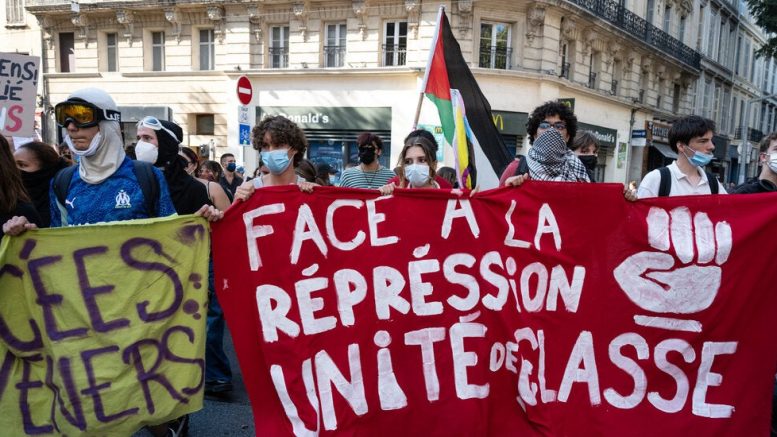
With images of young protesters clashing with the police amid clouds of tear gas, the student protests have become the most vivid manifestation of France’s unrest and grievances. Hundreds of schools around the country have closed, dozens have been damaged, and many people have been arrested or injured.
The street clashes have rattled financial markets that were already nervous. Traders kept the yield on 10-year French bonds near 5 percent on Monday, one of the highest levels of any European Union member and a sign that investors lack confidence in the lame-duck government’s ability to manage its mushrooming challenges.
“In France, we say ‘fin de règne,’” meaning the end of Mr. Macron’s decade-long reign over French politics, said Jean-Yves Camus, a political scientist at the Jean Jaurès Foundation, a left-leaning think tank in Paris. “The regime is at the end of its term and does not seem to have a plan for the next seven months.”
These deepening anxieties do not mean France is destined to suffer a Greece-style debt crisis or the kind of market backlash that toppled a British prime minister, Liz Truss, after she proposed budget-busting tax cuts in 2022.
Economists pointed out that other countries, including the United States, face pressure on their public finances because of rising interest rates. France’s anchor role in the European Union, they said, means that the bloc’s other members would bail it out, should it ever come to that.
“France’s position looks unsustainable and the bond markets are saying that, but they’re not screaming it yet,” said Kenneth Rogoff, a professor of economics at Harvard and a scholar of financial crises. “It’s a slow-motion train wreck.”
France, of course, is no stranger to social unrest, most recently the yellow-vest protests, which raged between 2018 and 2020. Tens of thousands of people, wearing high-visibility safety vests, turned out for weekly demonstrations that began as a protest against rising fuel prices and grew into demands for political and economic justice.
Some analysts note a disquieting similarity between that period and today, with oil and gas prices spiking as a result of the Iran war. Mr. Macron appears mindful of those dangers. Last Thursday, he chaired a meeting of leaders of Group of 7 wealthy democracies, in which they agreed to release 100 million barrels of diesel and crude oil from their stockpiles to ease pressure on fuel prices.
With French fishermen having blocked ports and fuel terminals to protest the cost of diesel, Mr. Macron said he hoped the emergency measure would cause prices to “drop at the pump as quickly as possible.”
Still, energy prices are only one piece of France’s precarious fiscal picture. The country’s public debt stands at roughly $4 trillion, which is 119 percent of its annual economic output. With rates on French government bonds spiking, the cost of servicing that debt is projected to increase to roughly $100 billion in 2027.
On top of that, France faces higher health care and pension costs because of its aging population, as well as increased military spending driven by the war in Ukraine and the disengagement of the United States.
To pay for all that, and keep France’s budget deficit from exploding, Prime Minister Sébastien Lecornu proposes to raise some taxes and freeze spending on social programs like housing aid and family allowances. Analysts said Mr. Lecornu was likely to get a budget passed, even if it takes months of messy negotiations and requires him to invoke special powers to push it through.
To do that, however, the government will have to rely on Ms. Le Pen’s party, the National Rally, not to torpedo the legislation. It has 118 of the 577 seats in the National Assembly, the most of any party. Some analysts expect Ms. Le Pen to order her lawmakers to abstain and allow the budget to pass, if only to protect herself from facing fiscal chaos if she wins the presidential election in April.
On Tuesday, Ms. Le Pen is scheduled to deliver a much-anticipated speech on her economic agenda. Analysts will dissect it for evidence that the National Rally has become more realistic about France’s fiscal problems since her last run for president, in 2022, when she was widely criticized as lacking credibility on economic policy.
While some analysts said they expected Ms. Le Pen to try to reassure bond markets about France’s deficit, they predicted she would continue to be implacably hostile to the European Union. If she were elected, they said, it would raise hard questions about France’s future contribution to the E.U.’s budget.
For that reason, some liken France’s election to the Brexit referendum in Britain, in which voters decided to break away from the European Union. “This is France’s 2016 moment,” said Mujtaba Rahman, an analyst who specializes in Europe at Eurasia Group, a political risk consultancy.
“It’s not just a debt crisis or bond-market crisis,” Mr. Rahman continued. “The investors I’m talking to are worrying about an existential political and constitutional crisis. It’s all of these issues coming together in a deeply unhelpful way for whoever wins the presidential election.”
A victory by Ms. Le Pen is far from preordained. She has been convicted of financial corruption, which she denies, and her party president, Jordan Bardella, has been accused of antisemitism, which he also denies. Analysts say that in a runoff against a centrist, Ms. Le Pen might lose.
But in another scenario, analysts said, the double whammy of economic problems and social unrest could play to the advantage of hard-line politicians on both the right and left. That could send Ms. Le Pen into a runoff against a far-left candidate whom she might more easily defeat.
Whoever prevails after this autumn of discontent, the crisis may force a more basic reckoning: France can no longer afford its social-welfare state.
“That is the deepest source of anger in France,” said Michel de Rosen, a French author and businessman. “We’re a country that can no longer do what it wants to do.”
Giulia Imbert contributed reporting.